Using Shapash with ShapIQ explainer
You can compute local contributions with the shapiq library and summarize them with Shapash.
Contents: - Build a Regressor - Create Explainer using ShapIQ - Compile Shapash SmartExplainer - Compare contributions with shap
Data from Kaggle House Prices
[1]:
# Optional if shapiq is not installed in your environment
# %pip install shapiq
[ ]:
import warnings
import numpy as np
import pandas as pd
from shapash.utils.dtypes import text_like_columns
from category_encoders import OrdinalEncoder
from lightgbm import LGBMRegressor
from sklearn.model_selection import train_test_split
import shapiq

# Silence known shapiq warnings used in this tutorial context.
warnings.filterwarnings(
    "ignore",
    message=r"Mismatch between max_order=2 and index=SV.*",
    category=UserWarning,
    module=r"shapiq\.explainer\.validation"
 )
warnings.filterwarnings(
    "ignore",
    message=r"Downcasting behavior in `replace` is deprecated.*",
    category=FutureWarning,
    module=r"shapiq\.explainer\.tree\.conversion\.lightgbm"
 )
[3]:
from shapash.data.data_loader import data_loading
house_df, house_dict = data_loading('house_prices')
[4]:
y_df = house_df['SalePrice'].to_frame()
X_df = house_df[house_df.columns.difference(['SalePrice'])]
Create Regression Model
[5]:
categorical_features = text_like_columns(X_df, strict_object=False)

encoder = OrdinalEncoder(
    cols=categorical_features,
    handle_unknown='return_nan',
    return_df=True
).fit(X_df)

X_df = encoder.transform(X_df)
[6]:
Xtrain, Xtest, ytrain, ytest = train_test_split(X_df, y_df, train_size=0.75, random_state=1)
[7]:
regressor = LGBMRegressor(n_estimators=200).fit(Xtrain, ytrain.values.ravel())
[LightGBM] [Info] Auto-choosing row-wise multi-threading, the overhead of testing was 0.002329 seconds.
You can set `force_row_wise=true` to remove the overhead.
And if memory is not enough, you can set `force_col_wise=true`.
[LightGBM] [Info] Total Bins 2986
[LightGBM] [Info] Number of data points in the train set: 1095, number of used features: 66
[LightGBM] [Info] Start training from score 182319.757078
Create ShapIQ Explainer
[8]:
X_background = Xtrain.sample(min(256, len(Xtrain)), random_state=1).values
X_eval = Xtest.reset_index(drop=True)

shapiq_explainer = shapiq.Explainer(
    model=regressor,
    data=X_background,
    index='SV',
    max_order=1
 )
[9]:
feature_names = list(X_eval.columns)

def first_order_values_to_array(interaction_values, n_features):
    if not hasattr(interaction_values, 'dict_values'):
        raise TypeError(
            "This shapiq version does not expose 'dict_values'; "
            "cannot safely map feature indices to contributions."
        )

    first_order = np.zeros(n_features, dtype=float)
    for coalition, value in interaction_values.dict_values.items():
        # For SV index, first-order effects are stored as singleton coalitions: (feature_index,)
        if isinstance(coalition, tuple) and len(coalition) == 1:
            first_order[int(coalition[0])] = float(value)

    return first_order
[10]:
shapiq_rows = []
for row in X_eval.values:
    iv = shapiq_explainer.explain(row)
    shapiq_rows.append(first_order_values_to_array(iv, n_features=len(feature_names)))

shapiq_contributions = pd.DataFrame(shapiq_rows, columns=feature_names)
Use Shapash With ShapIQ Contributions
[11]:
from shapash import SmartExplainer
[12]:
xpl = SmartExplainer(
    model=regressor,
    preprocessing=encoder,
    features_dict=house_dict
)
Use contributions parameter of compile method to declare ShapIQ contributions
[13]:
xpl.compile(
    contributions=shapiq_contributions.reset_index(drop=True),
    y_target=ytest.reset_index(drop=True),
    x=X_eval
)
[14]:
app = xpl.run_app(title_story='House Prices Shapiq', port=8020)
INFO:root:Your Shapash application run on http://PMP01087:8020/
INFO:root:Use the method .kill() to down your app.
Compare contributions to Shap library
Important note
shapiqandshapcan satisfy additivity while distributing contributions differently across features.A direct one-to-one match by feature is therefore not guaranteed, even when both methods explain the same prediction.
[15]:
xpl_shap = SmartExplainer(
    model=regressor,
    preprocessing=encoder,
    features_dict=house_dict
)
[16]:
xpl_shap.compile(
    y_target=ytest.reset_index(drop=True),
    x=X_eval
)
INFO: Shap explainer type - <shap.explainers._tree.TreeExplainer object at 0x11edd1a90>
[17]:
contributions = {
    'shapiq': xpl.contributions,
    'treeshap': xpl_shap.contributions
}
[18]:
from shapash.explainer.consistency import Consistency
[19]:
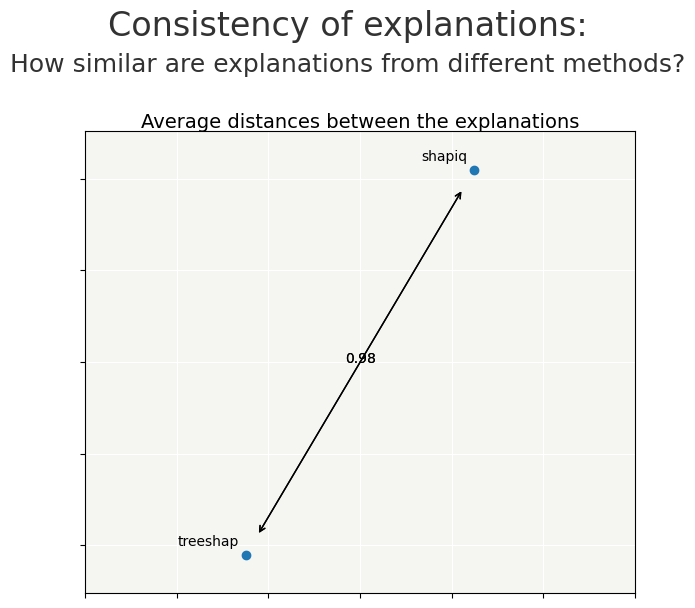
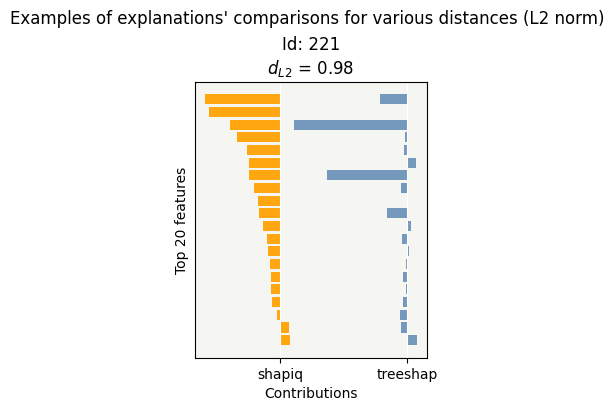
cns = Consistency()
cns.compile(contributions=contributions)
cns.consistency_plot()
Feature Importances And Feature Correlations
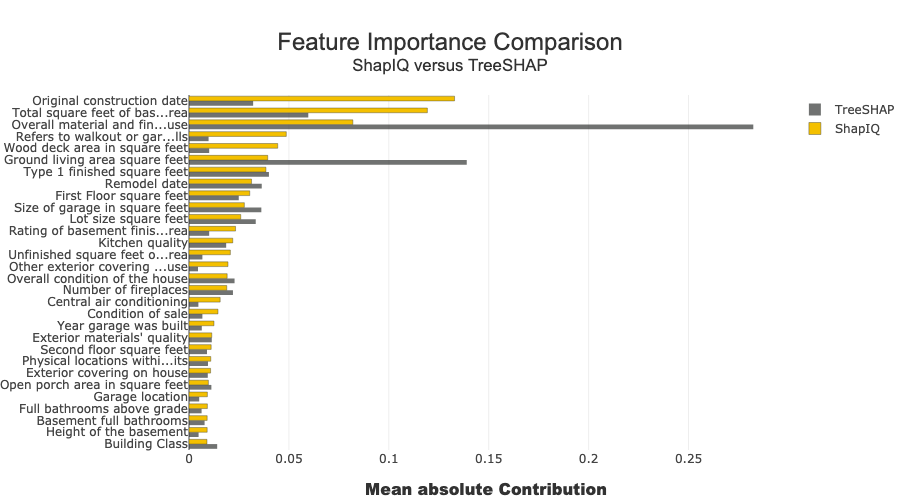
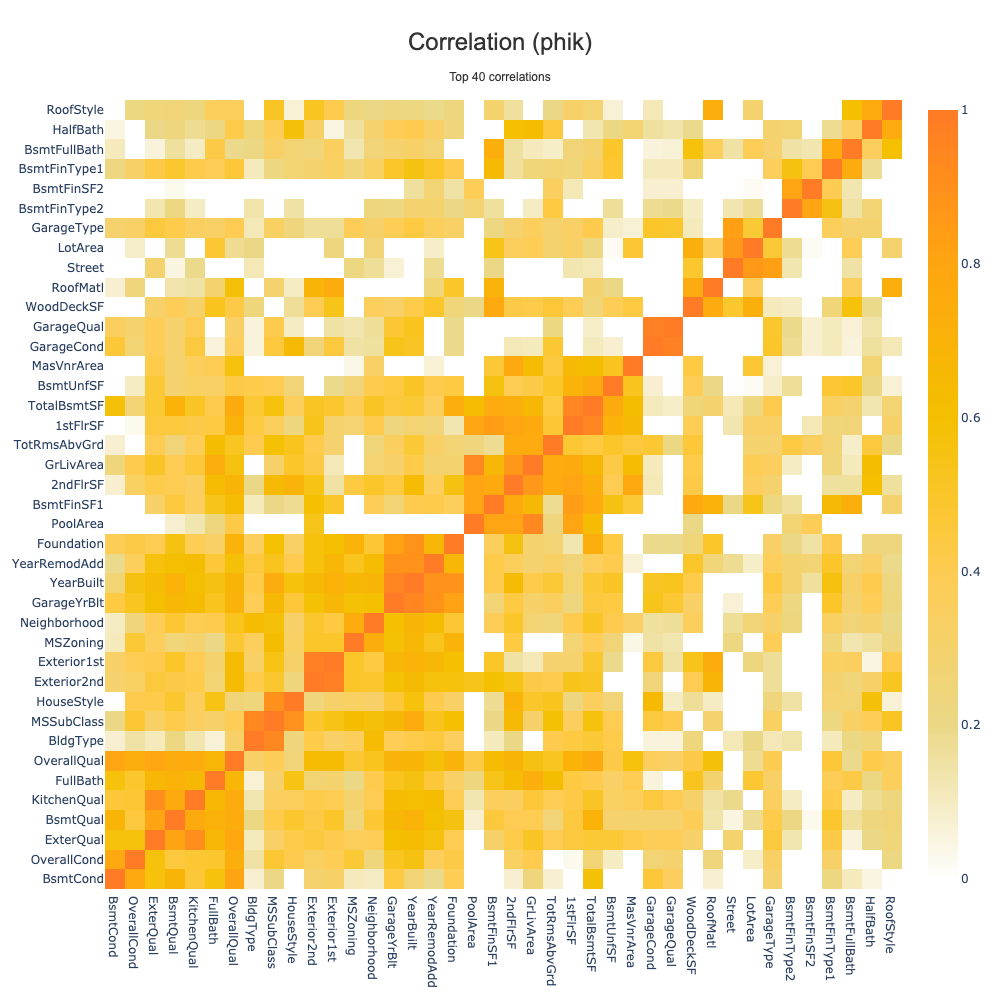
This section compares feature importances derived from ShapIQ and SHAP contributions, and visualizes the feature correlation matrix.
[20]:
from shapash.plots.plot_feature_importance import plot_feature_importance

xpl.compute_features_import(force=True)
xpl_shap.compute_features_import(force=True)

fi_shapiq = xpl.features_imp.sort_values().tail(30)
fi_shap = xpl_shap.features_imp.reindex(fi_shapiq.index)

fi_shapiq.index = fi_shapiq.index.map(xpl.features_dict)
fi_shap.index = fi_shap.index.map(xpl.features_dict)


fig_fi_compare = plot_feature_importance(
    mode="global",
    global_feat_imp=fi_shapiq.copy(),
    contributions_case=xpl.contributions,
    style_dict=xpl.plot._style_dict,
    subset_feat_imp=fi_shap.copy(),
    title="Feature Importance Comparison",
    addnote="ShapIQ versus TreeSHAP",
    global_feat_imp_name="ShapIQ",
    subset_feat_imp_name="TreeSHAP",
    width=900,
    height=500,
)
fig_fi_compare.show()
[21]:
# Correlation matrix with native Shapash plot
fig_corr = xpl.plot.correlations_plot(
    df=X_eval,
    max_features=40,
    height=1000,
    width=1000
 )
fig_corr.show()
Compare Explainability After Feature Selection
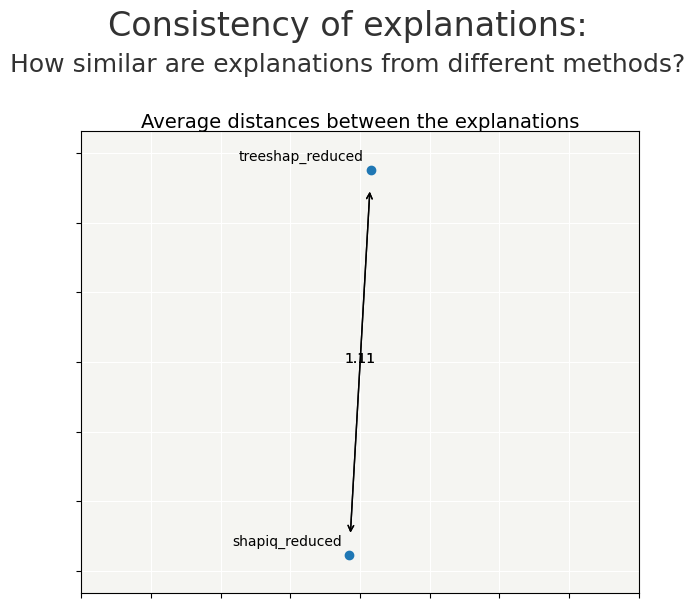
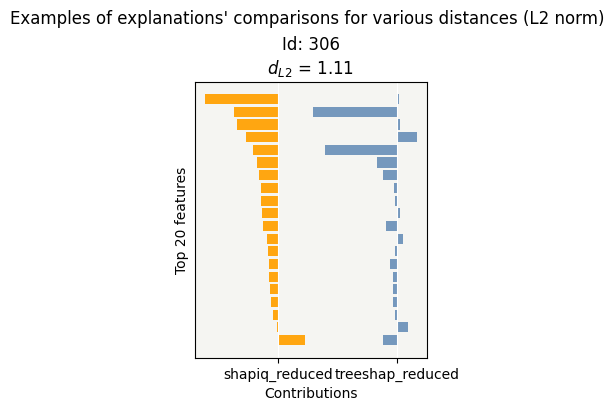
Use a sklearn feature-selection step, then remove highly correlated variables, and compare ShapIQ vs TreeSHAP on the reduced feature space.
[22]:
from sklearn.feature_selection import SelectFromModel

# 1) Model-based feature selection (LightGBM importances)
selector_model = LGBMRegressor(n_estimators=300, random_state=1)
selector_model.fit(Xtrain, ytrain.values.ravel())

selector = SelectFromModel(selector_model, threshold="median", prefit=True)
selected_mask = selector.get_support()
selected_features = Xtrain.columns[selected_mask].tolist()

print(f"Selected features after model-based filtering: {len(selected_features)} / {Xtrain.shape[1]}")
[LightGBM] [Info] Auto-choosing row-wise multi-threading, the overhead of testing was 0.001407 seconds.
You can set `force_row_wise=true` to remove the overhead.
And if memory is not enough, you can set `force_col_wise=true`.
[LightGBM] [Info] Total Bins 2986
[LightGBM] [Info] Number of data points in the train set: 1095, number of used features: 66
[LightGBM] [Info] Start training from score 182319.757078
Selected features after model-based filtering: 36 / 72
[23]:
# 2) Correlation-based filtering on selected features
Xtrain_sel = Xtrain[selected_features].copy()
Xtest_sel = Xtest[selected_features].copy()

corr_matrix = Xtrain_sel.corr().abs()
upper = corr_matrix.where(np.triu(np.ones(corr_matrix.shape), k=1).astype(bool))

corr_threshold = 0.90
to_drop = [col for col in upper.columns if any(upper[col] > corr_threshold)]
final_features = [f for f in selected_features if f not in to_drop]

Xtrain_red = Xtrain[final_features].reset_index(drop=True)
Xtest_red = Xtest[final_features].reset_index(drop=True)
ytrain_red = ytrain.reset_index(drop=True)
ytest_red = ytest.reset_index(drop=True)

print(f"Features after correlation filtering: {len(final_features)} / {len(selected_features)}")
print(f"Dropped (corr > {corr_threshold}): {len(to_drop)}")
Features after correlation filtering: 36 / 36
Dropped (corr > 0.9): 0
[24]:
# 3) Train reduced model
regressor_red = LGBMRegressor(n_estimators=200, random_state=1)
regressor_red.fit(Xtrain_red, ytrain_red.values.ravel())

X_background_red = Xtrain_red.sample(min(256, len(Xtrain_red)), random_state=1).values
X_eval_red = Xtest_red.reset_index(drop=True)
feature_names_red = list(X_eval_red.columns)

# 4) Compute ShapIQ contributions on reduced feature set
shapiq_explainer_red = shapiq.Explainer(
    model=regressor_red,
    data=X_background_red,
    index='SV',
    max_order=1
)

shapiq_rows_red = []
for row in X_eval_red.values:
    iv_red = shapiq_explainer_red.explain(row)
    shapiq_rows_red.append(first_order_values_to_array(iv_red, n_features=len(feature_names_red)))

shapiq_contributions_red = pd.DataFrame(shapiq_rows_red, columns=feature_names_red)
[LightGBM] [Info] Auto-choosing row-wise multi-threading, the overhead of testing was 0.001085 seconds.
You can set `force_row_wise=true` to remove the overhead.
And if memory is not enough, you can set `force_col_wise=true`.
[LightGBM] [Info] Total Bins 2724
[LightGBM] [Info] Number of data points in the train set: 1095, number of used features: 36
[LightGBM] [Info] Start training from score 182319.757078
The proxy could not connect to the destination in time.
URL:
(0.0.0.0)
|

[25]:
# 5) Compile two Shapash explainers on reduced feature space
xpl_shapiq_red = SmartExplainer(
    model=regressor_red,
    preprocessing=None,
    features_dict=house_dict
)
xpl_shapiq_red.compile(
    contributions=shapiq_contributions_red.reset_index(drop=True),
    y_target=ytest_red.reset_index(drop=True),
    x=X_eval_red
)

xpl_shap_red = SmartExplainer(
    model=regressor_red,
    preprocessing=None,
    features_dict=house_dict
)
xpl_shap_red.compile(
    y_target=ytest_red.reset_index(drop=True),
    x=X_eval_red
)

# 6) Compare consistency after feature selection
contributions_red = {
    'shapiq_reduced': xpl_shapiq_red.contributions,
    'treeshap_reduced': xpl_shap_red.contributions
}

cns_red = Consistency()
cns_red.compile(contributions=contributions_red)
cns_red.consistency_plot()
INFO: Shap explainer type - <shap.explainers._tree.TreeExplainer object at 0x129bf7920>
[26]:
from shapash.plots.plot_feature_importance import plot_feature_importance

xpl_shapiq_red.compute_features_import(force=True)
xpl_shap_red.compute_features_import(force=True)

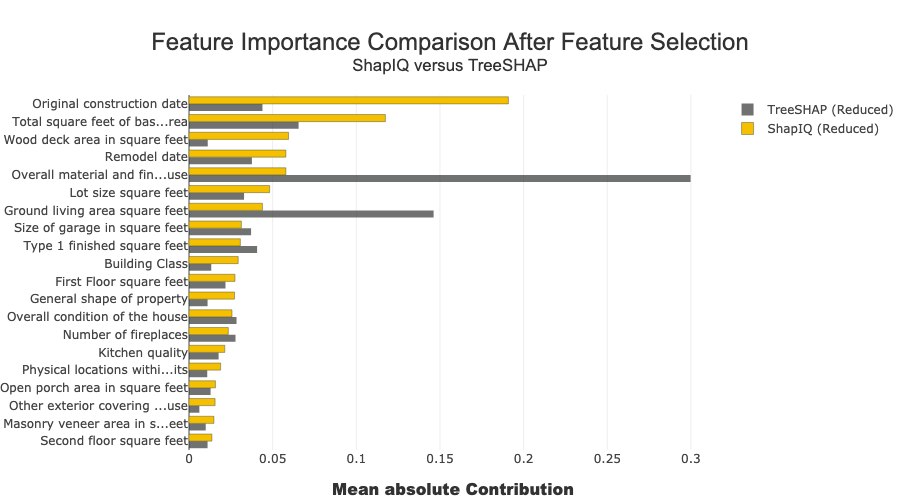
fi_shapiq_red = xpl_shapiq_red.features_imp.sort_values().tail(20)
fi_shap_red = xpl_shap_red.features_imp.reindex(fi_shapiq_red.index)

fig_fi_compare_red = plot_feature_importance(
    mode="global",
    global_feat_imp=fi_shapiq_red.copy(),
    contributions_case=xpl_shapiq_red.contributions,
    style_dict=xpl_shapiq_red.plot._style_dict,
    features_dict=xpl_shapiq_red.features_dict,
    subset_feat_imp=fi_shap_red.copy(),
    title="Feature Importance Comparison After Feature Selection",
    addnote="ShapIQ versus TreeSHAP",
    global_feat_imp_name="ShapIQ (Reduced)",
    subset_feat_imp_name="TreeSHAP (Reduced)",
    width=900,
    height=500,
)
fig_fi_compare_red.show()