
Shapash in Jupyter - Debugging a Titanic Model with Explainability
In this tutorial, we use explainability to detect a classic ML issue: target leakage.
You will: - build a deliberately flawed model - identify the bug using Shapash plots - fix the pipeline and compare performance - leave with a functional and numerical validation checklist
[ ]:
import pandas as pd

from category_encoders import one_hot
from lightgbm import LGBMClassifier
from sklearn.metrics import accuracy_score, precision_score, recall_score, f1_score
from sklearn.model_selection import train_test_split

from shapash import SmartExplainer
from shapash.data.data_loader import data_loading
1. Load Titanic data
[2]:
titanic_df, _ = data_loading("titanic")

# Same mapping logic as shapash/webapp/webapp_launch.py
titanic_df["Pclass"] = titanic_df["Pclass"].map({"First class": 1, "Second class": 2, "Third class": 3})

# Some dataset versions do not include Title: rebuild it if needed.
if "Title" not in titanic_df.columns:
    titanic_df["Title"] = titanic_df["Name"].str.extract(r",\s*([^\.]+)\.", expand=False).fillna("Unknown")

target_name = "Survived"
titanic_df[["Pclass", "Age", "Sex", "SibSp", "Parch", "Fare", "Embarked", "Title", target_name]].head()
[2]:
| Pclass | Age | Sex | SibSp | Parch | Fare | Embarked | Title | Survived | |
|---|---|---|---|---|---|---|---|---|---|
| PassengerId | |||||||||
| 1 | 3 | 22.0 | male | 1 | 0 | 7.25 | Southampton | Mr | 0 |
| 2 | 1 | 38.0 | female | 1 | 0 | 71.28 | Cherbourg | Mrs | 1 |
| 3 | 3 | 26.0 | female | 0 | 0 | 7.92 | Southampton | Miss | 1 |
| 4 | 1 | 35.0 | female | 1 | 0 | 53.10 | Southampton | Mrs | 1 |
| 5 | 3 | 35.0 | male | 0 | 0 | 8.05 | Southampton | Mr | 0 |
2. Common ML mistakes to keep in mind
These are exactly the kinds of mistakes explainability can uncover: - target leakage: a feature computed using the target (directly or indirectly) - business variables that are unavailable at prediction time - confusion between missing values and actual numeric values - unstable encoding between training and inference - metrics that are not suitable for imbalanced classes - feature engineering that depends on future information (time leakage)
3. Build a deliberately flawed model (with target leakage)
We create a leak_survival_rate_by_title variable using the true Survived target over the full dataset. This is a practical way to show how a suspicious feature immediately stands out in Shapash.
[ ]:
df_bug = titanic_df.copy()

# Intentional bug: target leakage (mean Survived computed on all rows)
df_bug["leak_survival_rate_by_title"] = df_bug.groupby("Title")[target_name].transform("mean")

features_bug = [
    "Pclass", "Age", "Sex", "SibSp", "Parch", "Fare", "Embarked", "Title",
    "leak_survival_rate_by_title",
]

X_bug_raw = df_bug[features_bug]
y = df_bug[[target_name]]

X_bug_train_raw, X_bug_test_raw, y_bug_train, y_bug_test = train_test_split(
    X_bug_raw,
    y,
    test_size=0.25,
    random_state=42,
    stratify=y,
)

encoder_bug = one_hot.OneHotEncoder(cols=["Sex", "Embarked", "Title"])
X_bug_train = encoder_bug.fit_transform(X_bug_train_raw)
X_bug_test = encoder_bug.transform(X_bug_test_raw)

model_bug = LGBMClassifier(max_depth=4, n_estimators=200, learning_rate=0.05, verbose=-1)
model_bug.fit(X_bug_train, y_bug_train.iloc[:, 0])
LGBMClassifier(learning_rate=0.05, max_depth=4, n_estimators=200, verbose=-1)In a Jupyter environment, please rerun this cell to show the HTML representation or trust the notebook.
On GitHub, the HTML representation is unable to render, please try loading this page with nbviewer.org.
Parameters
| boosting_type | 'gbdt' | |
| num_leaves | 31 | |
| max_depth | 4 | |
| learning_rate | 0.05 | |
| n_estimators | 200 | |
| subsample_for_bin | 200000 | |
| objective | None | |
| class_weight | None | |
| min_split_gain | 0.0 | |
| min_child_weight | 0.001 | |
| min_child_samples | 20 | |
| subsample | 1.0 | |
| subsample_freq | 0 | |
| colsample_bytree | 1.0 | |
| reg_alpha | 0.0 | |
| reg_lambda | 0.0 | |
| random_state | None | |
| n_jobs | None | |
| importance_type | 'split' | |
| verbose | -1 |
[4]:
def cls_metrics(y_true, y_pred):
    return {
        "accuracy": accuracy_score(y_true, y_pred),
        "precision": precision_score(y_true, y_pred, zero_division=0),
        "recall": recall_score(y_true, y_pred, zero_division=0),
        "f1": f1_score(y_true, y_pred, zero_division=0),
    }

y_bug_pred_train = model_bug.predict(X_bug_train)
y_bug_pred_test = model_bug.predict(X_bug_test)

metrics_bug = pd.DataFrame(
    [
        cls_metrics(y_bug_train.iloc[:, 0], y_bug_pred_train),
        cls_metrics(y_bug_test.iloc[:, 0], y_bug_pred_test),
    ],
    index=["train_bug", "test_bug"],
)
metrics_bug
[4]:
| accuracy | precision | recall | f1 | |
|---|---|---|---|---|
| train_bug | 0.913174 | 0.930435 | 0.835938 | 0.880658 |
| test_bug | 0.802691 | 0.791667 | 0.662791 | 0.721519 |
4. Explain the flawed model with Shapash
[5]:
feature_dict_bug = {
    "Pclass": "Ticket class",
    "Age": "Age",
    "Sex": "Sex",
    "SibSp": "Number of siblings/spouses",
    "Parch": "Number of parents/children",
    "Fare": "Ticket fare",
    "Embarked": "Port of embarkation",
    "Title": "Title",
    "leak_survival_rate_by_title": "SURVIVAL RATE BY TITLE (LEAK)",
}

postprocess = {
    "Age": {"type": "suffix", "rule": " years"},
    "Sex": {"type": "transcoding", "rule": {"male": "Man", "female": "Woman"}},
    "Pclass": {"type": "transcoding", "rule": {1: "First", 2: "Second", 3: "Third"}},
}

xpl_bug = SmartExplainer(
    model=model_bug,
    preprocessing=encoder_bug,
    features_dict=feature_dict_bug,
    label_dict={0: "Deceased", 1: "Survived"},
    postprocessing=postprocess,
    title_story="Titanic model debugging - buggy version",
)

y_bug_pred_test_df = pd.DataFrame(
    model_bug.predict(X_bug_test),
    columns=[target_name],
    index=X_bug_test.index,
)

xpl_bug.compile(
    x=X_bug_test,
    y_pred=y_bug_pred_test_df,
    y_target=y_bug_test,
    additional_data=df_bug.loc[X_bug_test.index, ["Name", "Title", "Fare", "Embarked"]],
)
INFO: Shap explainer type - <shap.explainers._tree.TreeExplainer object at 0x1228ec0e0>
[6]:
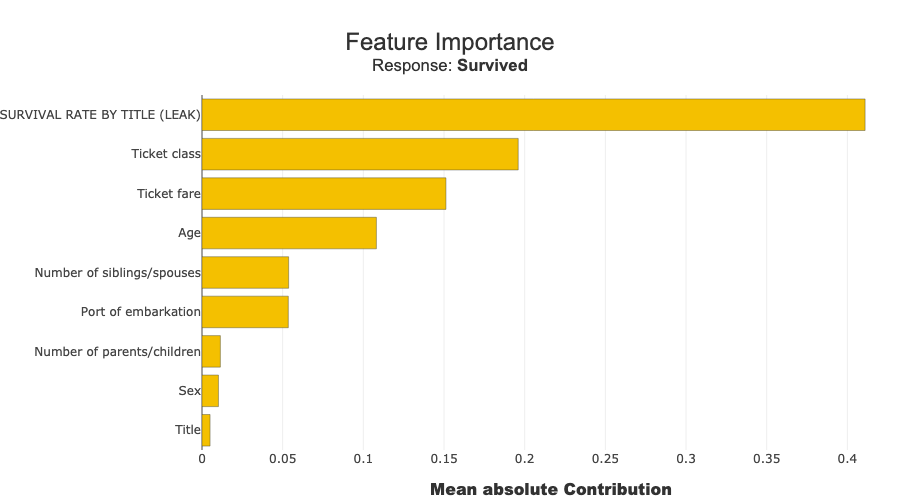
xpl_bug.plot.features_importance()
[7]:
xpl_bug.plot.contribution_plot("leak_survival_rate_by_title")
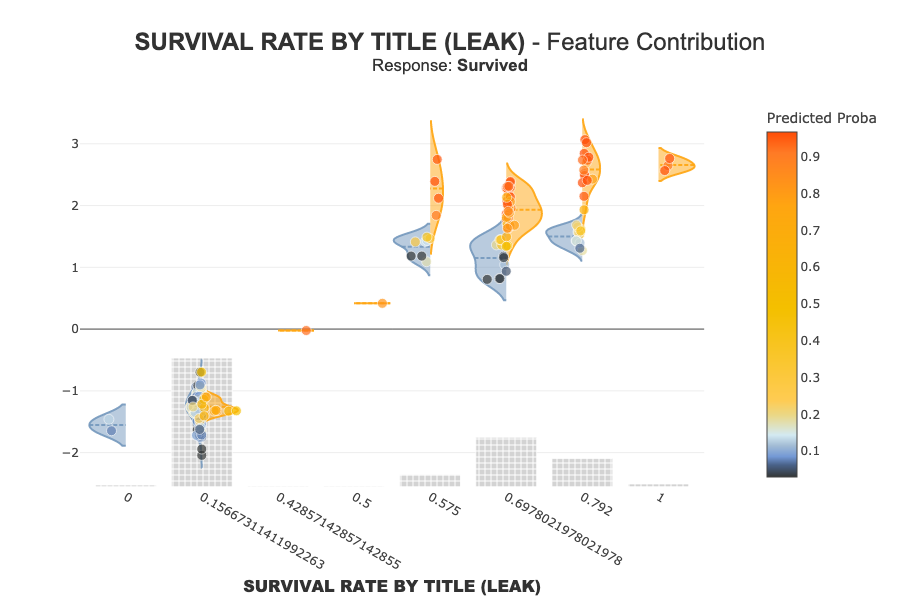
If SURVIVAL RATE BY TITLE (LEAK) is a dominant feature, this is a red flag: - this variable is not truly available in production - it contains information derived from the target - observed performance is overly optimistic
5. Fix the pipeline (without target leakage)
[ ]:
features_clean = ["Pclass", "Age", "Sex", "SibSp", "Parch", "Fare", "Embarked", "Title"]

X_clean_raw = titanic_df[features_clean]
y_clean = titanic_df[[target_name]]

X_clean_train_raw, X_clean_test_raw, y_clean_train, y_clean_test = train_test_split(
    X_clean_raw,
    y_clean,
    test_size=0.25,
    random_state=42,
    stratify=y_clean,
)

encoder_clean = one_hot.OneHotEncoder(cols=["Sex", "Embarked", "Title"])
X_clean_train = encoder_clean.fit_transform(X_clean_train_raw)
X_clean_test = encoder_clean.transform(X_clean_test_raw)

model_clean = LGBMClassifier(max_depth=4, n_estimators=200, learning_rate=0.05, verbose=-1)
model_clean.fit(X_clean_train, y_clean_train.iloc[:, 0])

y_clean_pred_train = model_clean.predict(X_clean_train)
y_clean_pred_test = model_clean.predict(X_clean_test)

metrics_clean = pd.DataFrame(
    [
        cls_metrics(y_clean_train.iloc[:, 0], y_clean_pred_train),
        cls_metrics(y_clean_test.iloc[:, 0], y_clean_pred_test),
    ],
    index=["train_clean", "test_clean"],
)
metrics_clean
| accuracy | precision | recall | f1 | |
|---|---|---|---|---|
| train_clean | 0.907186 | 0.925439 | 0.824219 | 0.871901 |
| test_clean | 0.798206 | 0.788732 | 0.651163 | 0.713376 |
[9]:
xpl_clean = SmartExplainer(
    model=model_clean,
    preprocessing=encoder_clean,
    features_dict={k: v for k, v in feature_dict_bug.items() if k in features_clean},
    label_dict={0: "Deceased", 1: "Survived"},
    postprocessing=postprocess,
    title_story="Titanic model debugging - cleaned version",
)

y_clean_pred_test_df = pd.DataFrame(
    model_clean.predict(X_clean_test),
    columns=[target_name],
    index=X_clean_test.index,
)

xpl_clean.compile(
    x=X_clean_test,
    y_pred=y_clean_pred_test_df,
    y_target=y_clean_test,
    additional_data=titanic_df.loc[X_clean_test.index, ["Name", "Title", "Fare", "Embarked"]],
)

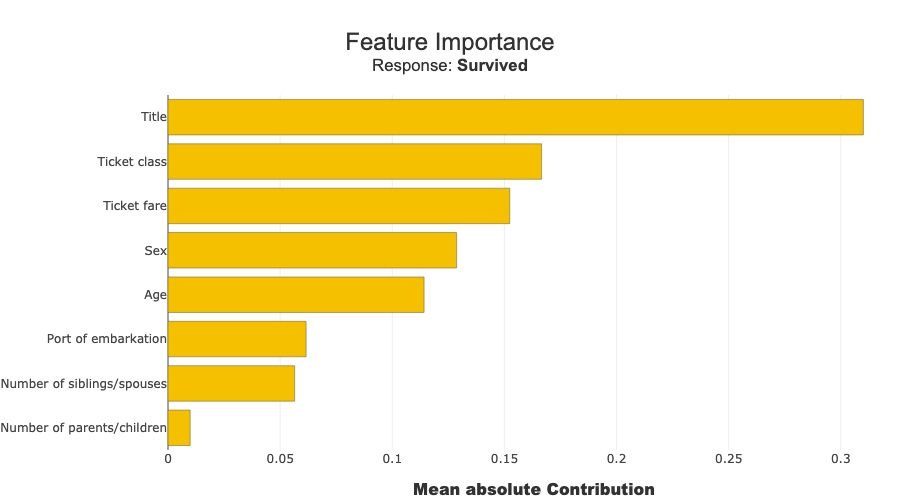
xpl_clean.plot.features_importance()
INFO: Shap explainer type - <shap.explainers._tree.TreeExplainer object at 0x122d1b2c0>
[10]:
comparison = pd.concat([metrics_bug, metrics_clean])
comparison
[10]:
| accuracy | precision | recall | f1 | |
|---|---|---|---|---|
| train_bug | 0.913174 | 0.930435 | 0.835938 | 0.880658 |
| test_bug | 0.802691 | 0.791667 | 0.662791 | 0.721519 |
| train_clean | 0.907186 | 0.925439 | 0.824219 | 0.871901 |
| test_clean | 0.798206 | 0.788732 | 0.651163 | 0.713376 |
6. Functional and numerical validation checklist
Apply this before production release:
Functional validation: - are all features available at prediction time? - are business rules stable over time? - is the target definition consistent with the business objective? - are edge business cases covered (rare profiles, extreme values)?
Data and numerical validation: - missing values: rate, imputation strategy, impact on predictions - outliers: plausible bounds, winsorization/capping if needed - train vs production distribution: drift on critical features - encoding: unknown categories, column order, expected numeric types - metrics: track precision/recall/f1, not only accuracy
7. Launch the Shapash webapp (optional)
As in shapash/webapp/webapp_launch.py, initialize the app and retrieve the Dash object.
[11]:
xpl_clean.init_app()
app = xpl_clean.smartapp.app
app
# Explicit launch: app.run_server(debug=False, host="0.0.0.0", port=8080)
[11]:
<dash.dash.Dash at 0x122d396d0>